 Wines



 Enotourism


 Gastronomy





 Events



Santiago is changing the way it welcomes its visitors. The evolution of traveller habits, the search for more authentic experiences in hotels and the need to combine relaxation, work and entertainment are giving way to a new generation of establishments that focuses on something different: less ostentation and more experience.
It is the phenomenon of lifestyle hotels. This is a concept that has been gaining ground in major cities around the world. It is beginning to assume an increasingly prominent role in our capital. These are hotels where design, identity, location, technology and efficiency carry as much weight as traditional services.
The phenomenon coincides with the ongoing importance of Santiago in domestic tourism. In July 2026, the Metropolitan Region reached a room occupancy rate of 73.8%, the highest recorded among the country's regions.
The decrease in regional overnight stays was 5% compared to July of the previous year. Even so, the capital retains its importance as a tourism and business destination.
In this scenario, new investments seek to cater to a different kind of traveller. They do not want to pay for a list of services they will use little, but rather for the elements that impact their stay.
And one of the projects that best reflects this transformation already has a name, location and date: OLÁ Costanera Tapestry Collection by Hilton, the second hotel under the OLÁ brand, which will be built on the corner of Avenida Andrés Bello and La Concepción, in Providencia.
A new gamble
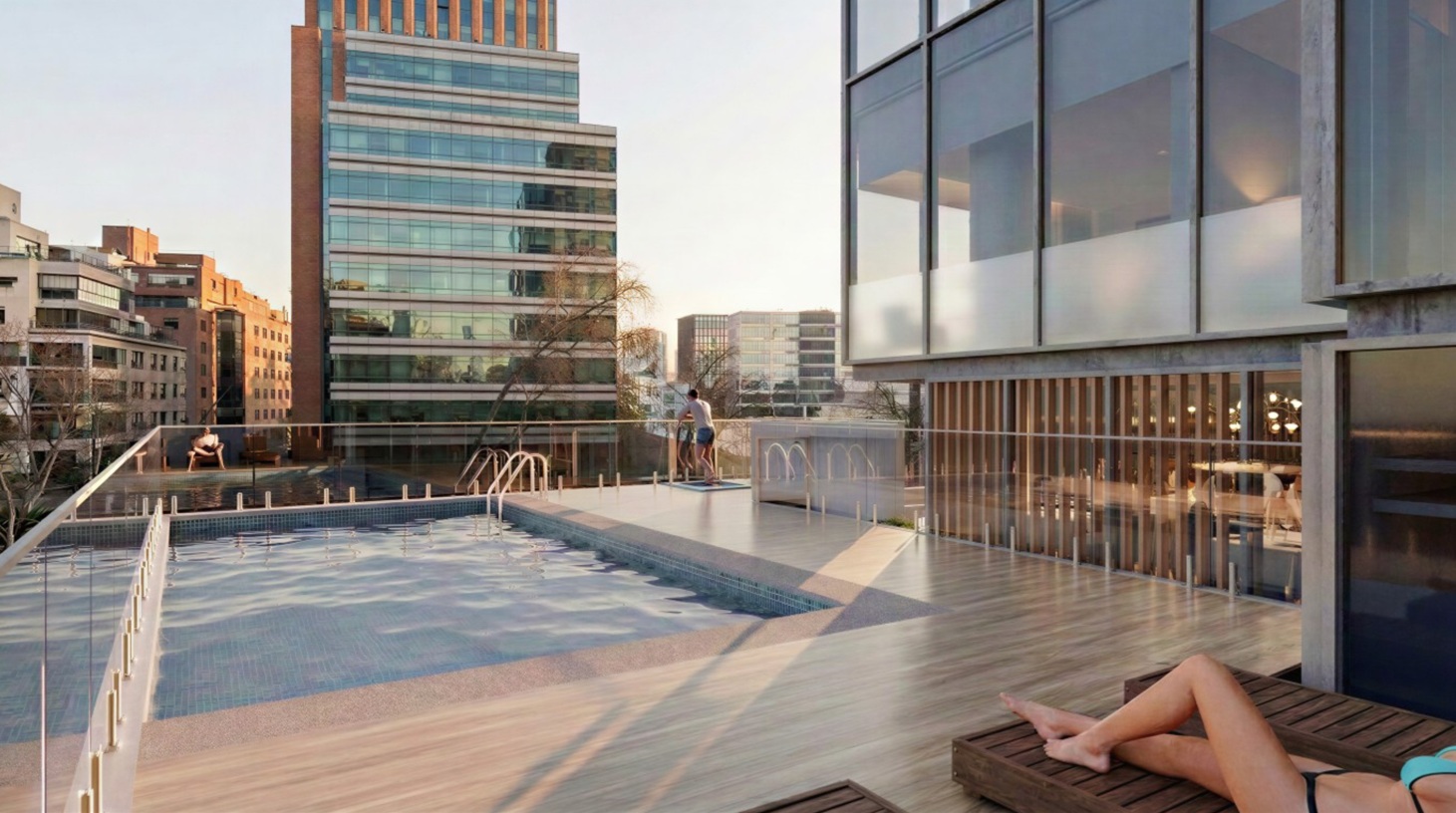
The opening is scheduled for early 2028 and involves the transformation of a recently built office building into a 231-room hotel, with an investment of over US$20 million in fit-out work by OLÁ Hotel.
The project will have four function rooms, a gym, a swimming pool and a breakfast bar with a spacious terrace on the third floor. One of its great attributes will be the panoramic view of Santiago.
The development will be carried out through a long-term lease agreement with BICE Vida, the property owner. The operation also constitutes an example of asset conversion: a building originally intended for offices will have a new lease of life as tourism infrastructure, generating activity, employment and services in its surrounding area.
For Cristóbal Dib, general manager of OLÁ Hotel, the project is part of a growth strategy that seeks to take advantage of urban locations where the brand's proposition makes sense. “To grow, we first demonstrated that the model sustains itself in a balanced way across occupancy, rate, service quality and efficiency. That gives us a great deal of flexibility and speed to market,” he points out.
The project allows us to observe how the concept of a luxury hotel is changing. For years, luxury was associated with large spaces, numerous services, and an experience based on abundance. Today, Dib explains, the guest is looking for something else.
“For us, contemporary luxury has less to do with ostentation and much more to do with prioritising the quality of the experience over the quantity of service,” she states.
OLÁ's proposal seeks precisely to concentrate resources on what the passenger truly values. Hence, services such as Wi-Fi and private parking are part of the core experience and not additional charges. “If something is necessary for the experience to work well, we believe it should be part of the proposal and provided with excellence,” Dib explains.
Providencia, the neighbourhood changing the map
The choice of Providencia is not by chance either. The commune concentrates business, gastronomy, commerce, culture and connectivity, as well as some of Santiago's main corporate hubs.
For today's traveller, that combination makes it possible to work, get around, eat, shop and get to know the city without having to travel long distances. “Providencia has something very difficult to replicate: it combines business, gastronomy, commerce, culture, connectivity and urban life in the same environment,” maintains Dib.
OLÁ Providencia itself is located about a seven-minute walk from Costanera Center and Tobalaba station. The idea, explains the general manager, is for the guest to be in the centre of urban activity and, upon stepping through the hotel door, to find a space of calm. That duality—city and disconnection—is precisely one of the characteristics that defines the new urban traveller.
In lifestyle hotels, the room also takes on a new meaning. The objective is not necessarily to fill the space with technological elements or services, but to ensure that everything works properly and that the guest can rest.
In OLÁ, this translates into specially designed mattresses, a pillow menu, soft sheets, adaptable lighting and strong acoustic and light insulation.
“It would probably be a room where no appliance draws too much attention, because they simply work to perfection,” Dib describes. The idea is that after a day of meetings or touring Santiago, the traveller can return to a space designed to recover energy.
The arrival of OLÁ Costanera also has a concrete precedent. OLÁ Providencia, the brand's first hotel, has been operating since 2019 and has maintained an occupancy rate of over 80% for the last two consecutive years. The hotel records a RevPAR 15% higher than its competitive set and welcomes more than 40 thousand guests a year.
He was also honored by Hilton with an Award of Excellence, which placed him as the sixth best Tapestry Collection hotel worldwide, and he was recognised by Tripadvisor within the Top 10 of the Traveller's Choice Awards.
For this very reason, OLÁ Costanera will maintain the same DNA as the first property—relaxation, design and efficiency—but will have its own identity related to the neighbourhood where it will be located.
“OLÁ Costanera is born with the same DNA as the previous one - a good night's sleep, detailed design and a practical and efficient experience -, but with its own identity that connects it to its environment,” states Dib.
Thus, as Santiago continues to consolidate its position as a destination that combines tourism, business and urban life, new industry players are beginning to bet on a different formula.
The project represents the arrival of a hospitality concept that understands luxury differently and is committed to the idea that, for the modern traveller, the best experience is not necessarily the one that offers the most, but the one that offers exactly what they need.
“Juntas Secretas”: wine, tourism and new connections in Colchagua