 Wines

 Enotourism


 Gastronomy





 Events


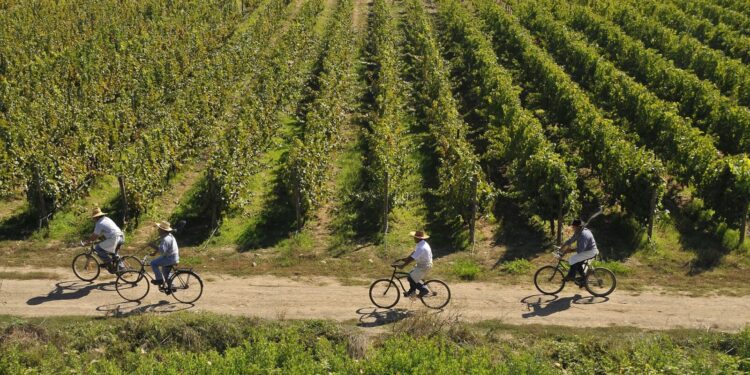
Climate change is profoundly redefining the future of wine worldwide. And it is in this scenario that Miguel Torres Chile continues to strengthen its work in environmental measurement and management.
This is with the understanding that producing wine today also entails taking on an active responsibility towards the land, resources and, in particular, future generations.
And that is why the family winery of Curicó Valley has just completed its external carbon footprint verification audit carried out by the company LRQA, achieving new results compared to its 2018 base year.
The report shows a 30% reduction in the total measured value. There has also been a 22% fall in emission intensity. This indicator takes into account the kilograms of CO₂ equivalent emitted per bottle or litre of wine produced.
This Greenhouse Gas (GHG) inventory was carried out in accordance with ISO 14065 and covers all emissions across all categories (1, 2, 3, 4 and 5).
Beyond the numbers, Miguel Torres Chile highlights the importance of measuring on a regular basis. This practice helps to understand the impact of winemaking activity and to guide future decisions. Given a scenario where wine production will be more challenging.
“For wine, talking about sustainability is no longer an option, but a necessity. The climate is changing our regions, our harvests and our ways of producing. Measuring, understanding and managing our emissions is part of the commitment we undertake as a company and as an industry, points out Jaime Valderrama, general manager of Miguel Torres Chile.
Future objectives and challenges
The results show cross-cutting decreases across different areas evaluated. Although part of these variations may be linked to operational dynamics typical of complex periods for the sector.
The company also highlights the sustained work in specific areas, such as the management of refrigerant consumption, through more planned maintenance and continuous monitoring of this factor.
Furthermore, the work surrounding energy efficiency, driven by the use of renewable energies and the replacement of conventional equipment with low-consumption alternatives, has been decisive.
The winery’s stated goal remains clear: to achieve a 50% reduction by 2030. However, the path to this goal involves implementing more far-reaching measures, including investment, technological innovation and changes to production processes and the supply chain.
Future challenges include alternatives such as renovating energy systems based on fossil fuels. Moving towards electromobility and greater integration of strategic suppliers are priorities. In particular, high-impact industries, such as glassware, must participate in emission measurement and reduction processes.
For Miguel Torres Chile, the challenge is not limited to the proposed goals. The path seeks to reduce the footprint of its activity on the planet. Progress is being made towards a greater objective: carbon neutrality, with a balance between emissions and mitigation that can reach zero.
Wine Day 2026 will be celebrated at La Moneda and at the MUT.